
That unconsented deck — %%is it a problem%%?
A two-minute decision tree that tells you whether building work on a property you're buying is compliant, needs a Certificate of Acceptance, or will cost you down the track. Covers both pre- and post-1992 work under Auckland Council rules.

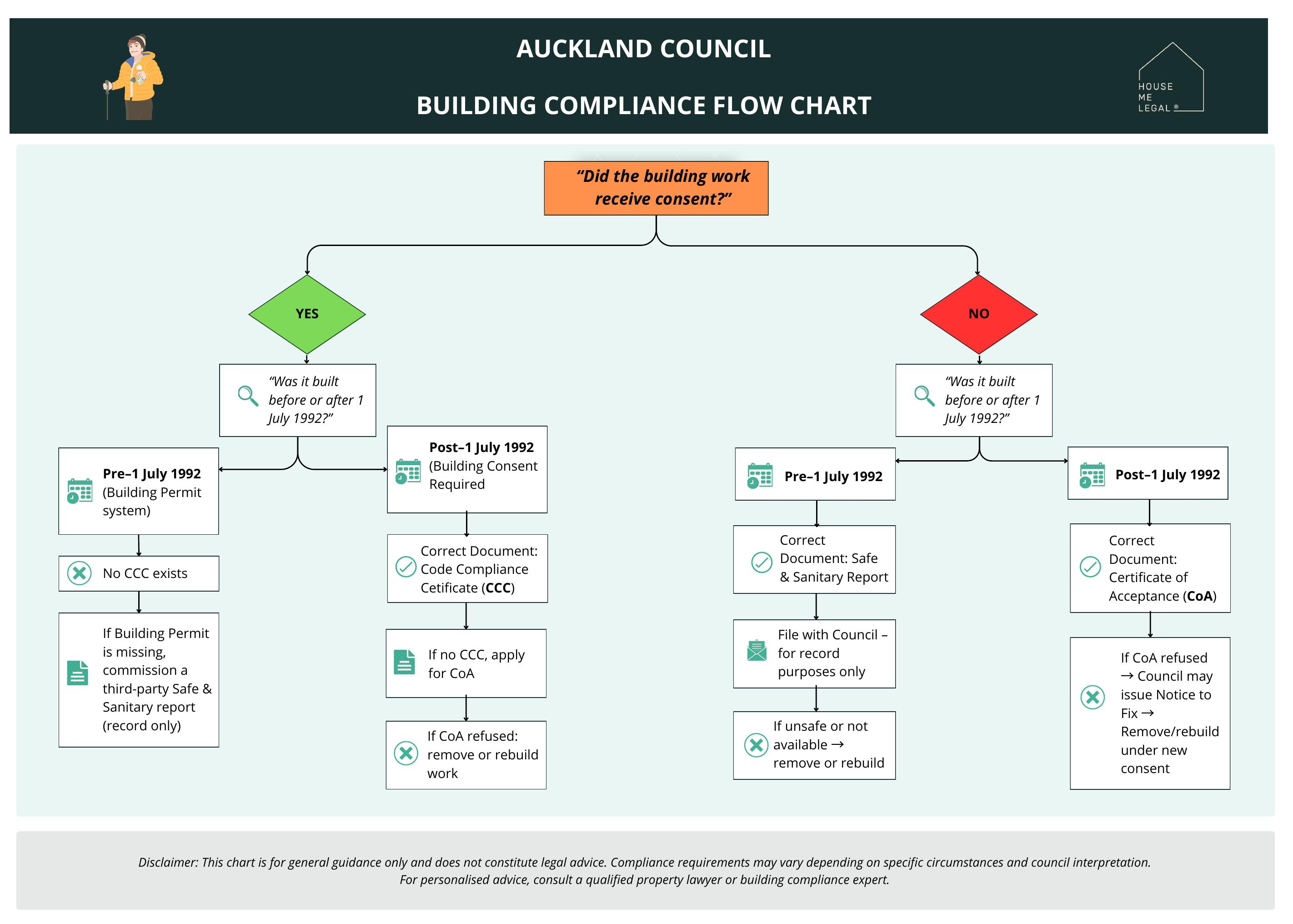
Two questions. Four outcomes.
The flowchart starts with a single question about the building work in front of you, branches on one more, and delivers the exact document you need to request — or the next action you should take.
Did the building work receive consent?
Was it built before or after 1 July 1992?
Pre-1992 → request the Building Permit; if missing, a Safe & Sanitary report
Post-1992 → request a Code Compliance Certificate; if none, apply for a CoA
Was it built before or after 1 July 1992?
Pre-1992 → Safe & Sanitary report on file with council
Post-1992 → apply for a Certificate of Acceptance; if refused, Notice to Fix
Use this flowchart when…
You're looking at a LIM report, a building report, or an Auckland property listing and something doesn't add up. Run the flowchart. It'll tell you whether you need to push for documents, walk, or proceed.
The LIM report mentions work on the property but there's no Code Compliance Certificate.
The building report flags an unconsented deck, carport, garage conversion, or internal alteration.
The property is pre-1992 and the council file is thin.
The vendor's agent says "it's fine, it doesn't need consent" and you want to verify.
You're considering an offer and need to decide what documents to request under the due diligence condition.

Angus Grayson, LLB
Unconsented work is the single most common problem I find in first home buyer due diligence. I built this flowchart so buyers and their brokers can run the diagnostic themselves and know what to ask for — before they're deep into a contract.
Send me the flowchart.
Enter your details and we'll email you the PDF immediately. No spam, and you can unsubscribe any time.
Before you download.
Does this apply outside Auckland?
The framework — consent status, pre- or post-1992, what document to ask for — is the same across New Zealand under the Building Act 2004 and its predecessors. The flowchart is built against Auckland Council processes; other councils use slightly different terminology but the logic holds.
What if I'm already under contract?
If you're within a due diligence or builder's report condition period, you can still run the flowchart to work out what to request before those conditions lapse. If you're already unconditional, it's less a decision tool and more a scope-of-work guide for putting it right.
Can my building inspector or mortgage broker use this?
Yes. Brokers often use it to frame up the issue for clients in the week after a building report lands.
Is a Certificate of Acceptance the same as a Code Compliance Certificate?
No, but they're close cousins. A CCC is issued when work was done under a consent and meets the code. A CoA is issued retrospectively for work that should have had a consent but didn't — council inspects what's there and decides whether it's acceptable.