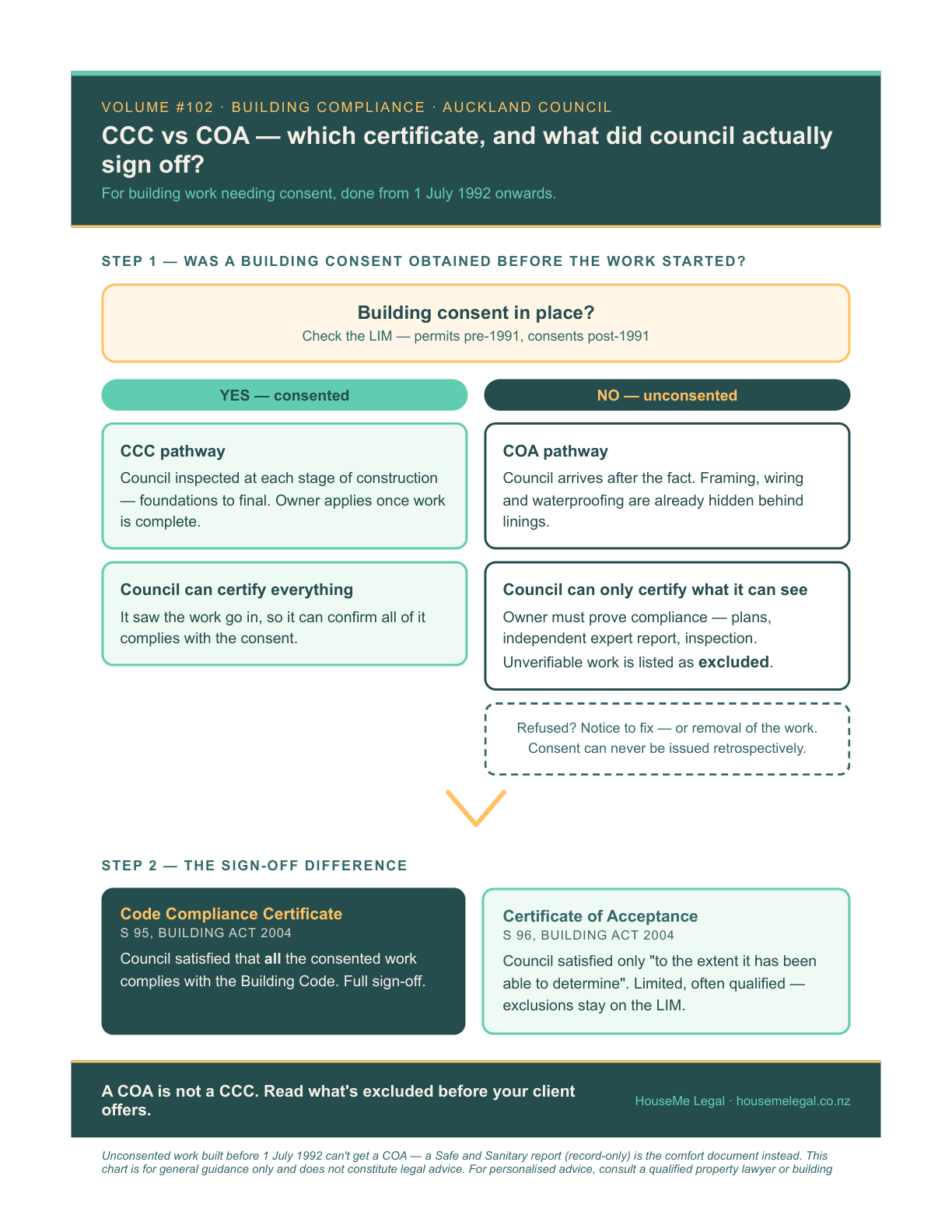
Council only certifies what it could see — and the exclusions follow the property on the LIM. The five-minute check before your client offers.
Both a Code Compliance Certificate and a Certificate of Acceptance come from the council, and both say the work meets the Building Code. They are not the same thing, and the gap between them is what your client inherits on settlement day.
A CCC (section 95) means the council watched the work happen — staged inspections from foundations to final — and is satisfied everything under the consent complies. A COA (section 96) is for work done without a consent: the council turns up after the fact, when the framing, wiring and waterproofing are already hidden behind linings, so it only covers what could actually be seen or verified. The council’s own guidance calls it “limited assurance.” A CCC certifies everything; a COA certifies what was visible. Anything the council couldn’t verify is listed as excluded, and that list sits on the LIM forever.
When a LIM shows a COA, don’t read it as “sorted.” Read the certificate itself: what’s covered, what’s excluded, and whether the bank and insurer have seen both lists — the same disclose-before-you-apply rule that applies to any missing sign-off. If a seller says “we’ll just get a COA before settlement,” price that condition properly — it starts at over $1,400 before plans and reports, the burden of proof sits on the applicant, and the twenty-working-day clock stops every time the council asks for more. The adviser’s question is the same as always: when was it built? Pre-1 July 1992 unconsented work can’t get a COA at all, and consented-but-never-signed-off work needs a CCC, not a COA.