The townhouse is 90% built, title has issued and only the Code Compliance Certificate is outstanding. Of forty pages of developer’s terms, six clauses still have teeth. Here they are, and here is the one that lands on your desk.
A broker sent me a file last week. His client had signed for a new-build townhouse off the plans. Since then the builders have done their job: the building is up, the subdivision is through, and a record of title has issued for the lot. Painters and landscapers are on site. Council has not yet issued the Code Compliance Certificate.
His question: the agreement has forty pages of the developer’s own Further Terms. How much of that still matters now?
Less than you would think. The clauses that still matter are not the ones his client was worried about.
THE CAKE
When your client buys an existing house, the agreement is the standard ADLS form. Everyone has seen it and there is not much to say.
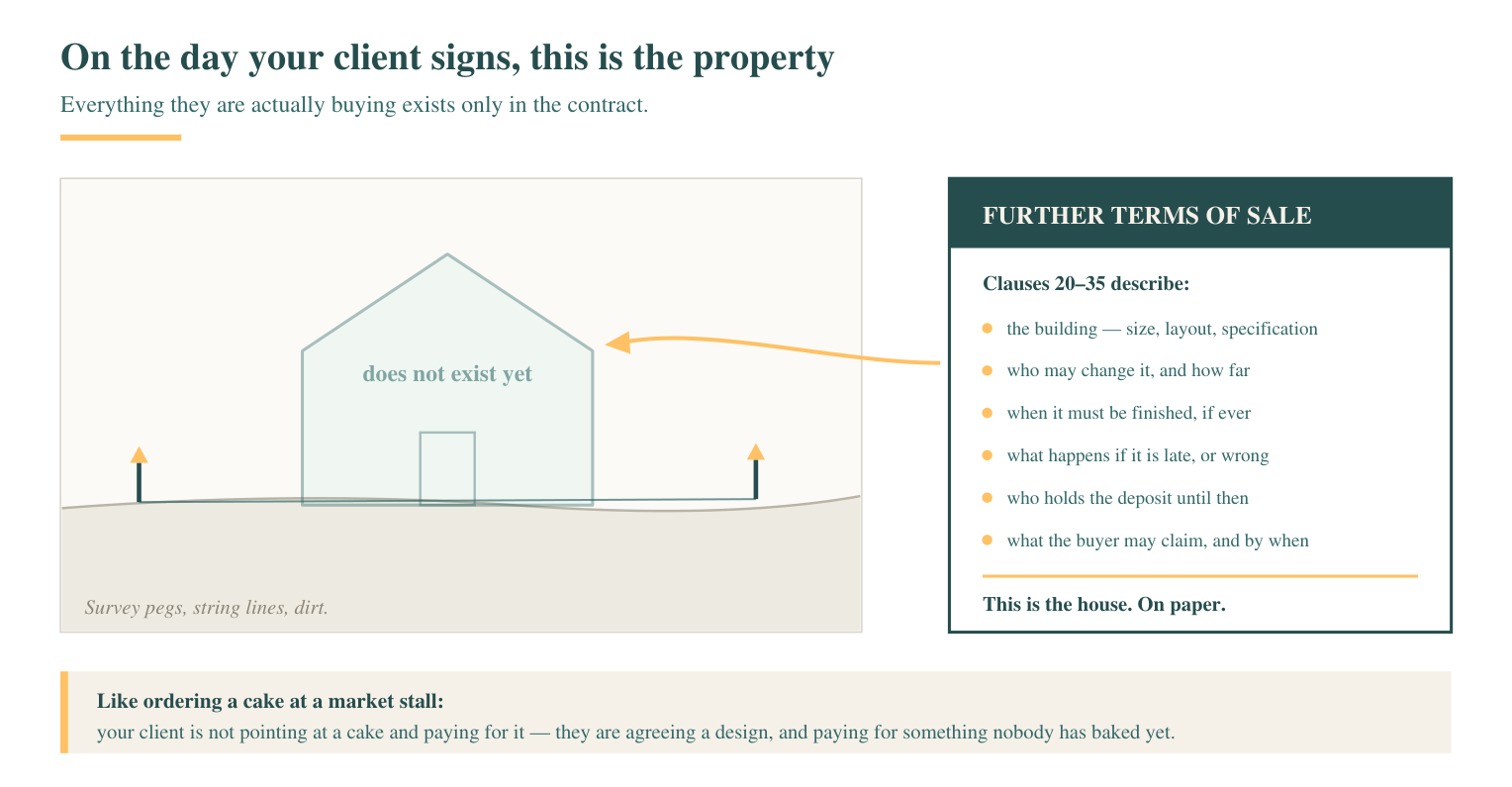
A new build is different. Clauses 20 to 35 are the developer’s own drafting, and they exist because on the day your client signs, the building does not exist.
Think of ordering a cake at a market stall. You are not pointing at a cake and paying for it. You agree a design, three tiers, lemon, ready by June, and hand over money for something nobody has baked. Every question you would ask at that stall is a clause in a developer’s contract:
The Further Terms are not there to be unfair. They describe a building that only exists on paper and allocate every risk in the gap between the drawing and the finished thing.
THE SHIFT
This is the most useful thing you can tell a client, and most people miss it.
The developer’s clauses are front-loaded. They were written for the start of the purchase, when the section has survey pegs on it and nothing else. At that point almost all of them are live and a proper review works through every one.
By the time the building is 90% done, most have nothing left to bite on. The developer’s right to change the plans means little once the plans are standing in timber and plasterboard. The absence of a promised completion date matters less when completion is weeks away. The vendor’s own finance condition expired months ago.
So the review changes shape. It stops asking what might be built and starts asking what has been built, and what your client can do about it.
Put plainly: the risk moves from the developer’s timing to the quality of the finished house, and to your client’s ability to settle on time.
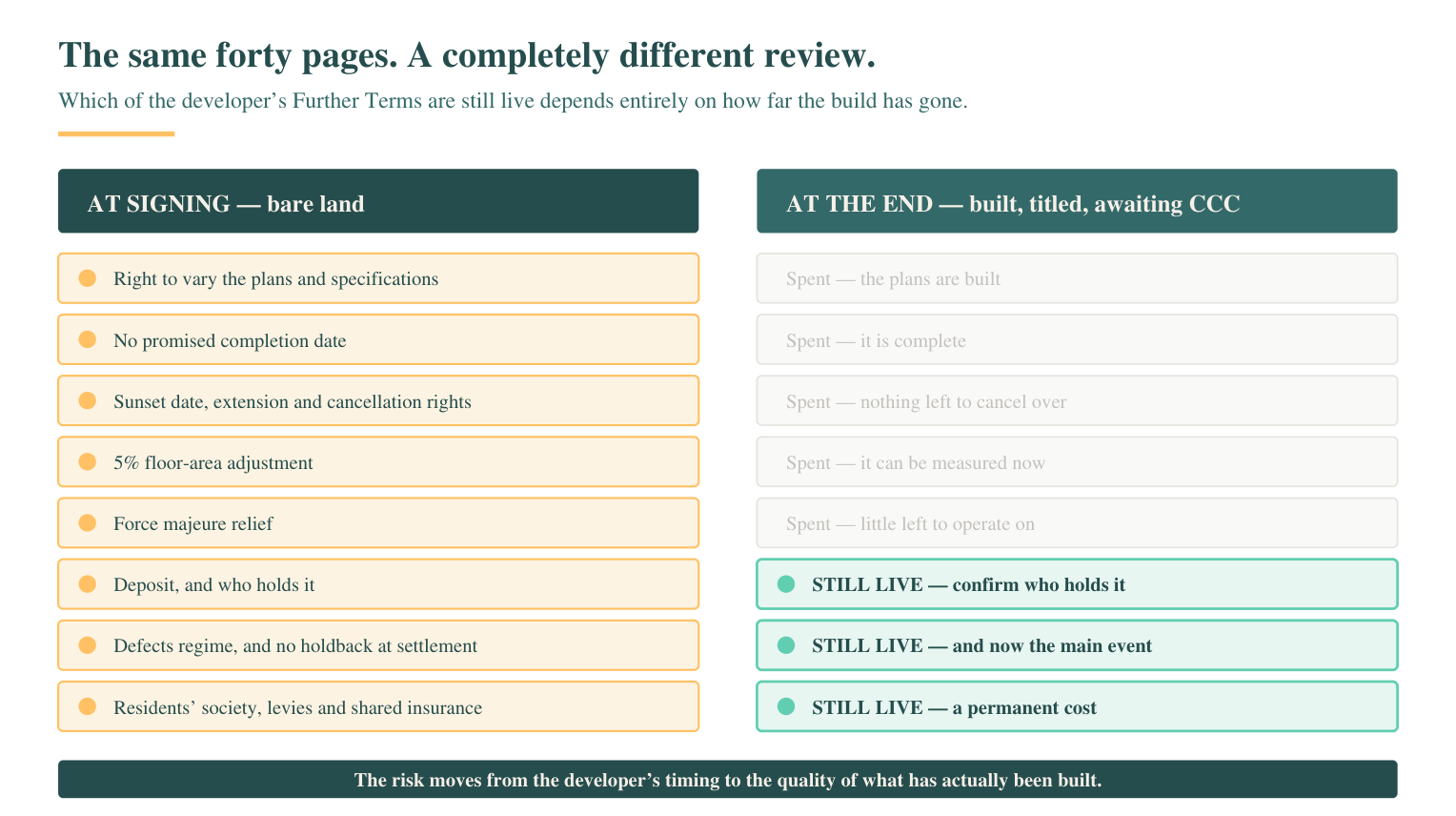
We have built this into an interactive tool. Drag the slider from bare land to move-in day and watch each clause switch off as the house goes up, pinned to the part of the house it is about. It sits on our Tools page for you and your clients: the New Build Further Terms tool.
Open the New Build Further Terms tool →
WHAT STILL MATTERS
Settlement is the later of three triggers: five working days after the vendor’s lawyer advises title has issued, five working days after the buyer’s lawyer receives the CCC, and five working days after a certificate of Practical Completion. Title is done. The other two are not. Until the CCC lands there is no settlement date at all, not a soft one, not a provisional one. Developers will give you a target. A target is not a certificate.
Settlement Date definition, paraphrased: Settlement happens on whichever comes last: five working days after the vendor’s lawyer confirms the title has issued, five working days after the buyer’s lawyer is given the Code Compliance Certificate, or five working days after they are given a certificate confirming Practical Completion.
Clause 25.6 in this contract says the buyer must pay the full price on settlement. No withholding, no retention, no set-off for defects. In exchange there is a defects regime.
Clause 25.6, paraphrased: The buyer must pay the whole of the balance on settlement day and cannot hold back any part of it, ask for a retention, or set off any claim against the price.
Read that against the point above. On settlement morning your client has no financial lever. If they walk through and find a cracked tile or a door that does not close, they still pay the full price that day and chase the fix afterwards. Everything they want fixed has to be found and put in writing before settlement. That makes an independent NZS 4306 defects inspection the most useful thing a buyer can spend money on at this stage.
Twelve months from Practical Completion for defective building work under the Building Act. Twelve months from settlement for any other defect. Both need written notice inside the window. The two clocks start at different events, and Practical Completion can be certified weeks before settlement. Anything not spotted and put in writing in time, your client carries.
Clauses 23.7 and 23.8, paraphrased: The vendor will meet its Building Act obligations to fix defective building work that the buyer notifies within twelve months of Practical Completion. Separately, any other defects or faults that appear within twelve months of settlement, and are notified to the vendor in writing inside that period, will be fixed by the vendor at its own cost within a reasonable time.
Clause 27.11 adds a sting. If the buyer skips the pre-settlement inspection, they are deemed to have accepted the property as it stands.
Clause 27.11, paraphrased: If the buyer does not carry out a pre-settlement inspection, or agree in writing to one on a later date, the buyer is treated as having inspected the property, chattels and fixtures and accepted them as at the settlement date.
If the property does not match what was sold, the remedy is compensation only, and only if demanded in writing before settlement. After settlement the right is gone.
Clause 25.5, paraphrased: No error or misdescription of the property, the building or the title will cancel the sale. The buyer’s only remedy is compensation, and only if it is demanded in writing before the settlement date.
The deposit goes to a named stakeholder and is held, not paid to the developer. Two things to check. Developers change law firms mid-project, and the contract may still name the old one. Confirm who actually holds the money before it moves. And if the deposit is coming from KiwiSaver, the funds have to sit with a stakeholder while the agreement is conditional. On our recent file the KiwiSaver withdrawal was lodged and paid out during the due diligence period, which meant the deposit was ready the day the client confirmed.
Clauses 21.1 and 21.2, paraphrased: The deposit is paid to the named Stakeholder on the later of the agreement date or the date the buyer confirms the due diligence condition. The Stakeholder may hold it in an interest-bearing trust account, and the interest, after tax and the Stakeholder’s charges, follows the deposit.
Terraced developments with a shared driveway almost always carry a residents’ society: one insurance policy over every dwelling, shared maintenance of the accessway, and a set of rules about what you can hang in your windows. It works like a light body corporate.
This is not a transaction risk. It is a permanent annual cost, and on a brand-new development the operating levy is often not set when your client is asked to go unconditional. The insurance share usually is. Get the actual figure for your client’s lot from the society’s constitution, not the developer’s estimate.
Clause 25.3, paraphrased: The vendor may register whatever encumbrances it or the council considers necessary, and the buyer takes title subject to them with no right to object or claim compensation. These may include a land covenant setting up a residents’ society that insures every dwelling under one policy, manages and maintains the shared access lot and other common assets, and imposes rules on owners: nothing hung in windows other than proper window furnishings, no commercial use beyond a home office, keep the exterior and grounds tidy, and use materials and colours consistent with the resource consent. Every property bears a fair share of the insurance, management and maintenance costs.
One consequence for you: because the society insures the buildings, your client does not take out their own replacement policy. The lender is noted on the society’s policy instead. That catches people at loan-document stage.
WHAT HAS ALREADY SPENT ITSELF
Clause 23.4, paraphrased: The plans and specifications are drafts. The vendor may alter them to meet the needs of other buyers or the terms of consents, to improve marketability, or as it otherwise decides.
Clauses 23.5 and 23.6, paraphrased: Measurements may change on checking by the council, builder or surveyor and neither party can claim for that. But if the finished floor area is more than 5% smaller than the plan, the price is reduced by the percentage over 5%.
Clauses 23.2, 24.1 and 24.2, paraphrased: The vendor is not responsible for delays outside its control, including weather, materials, contractor disputes, market conditions, or council and LINZ delays. Any completion dates it gives are indicative only. It gives no warranty about when Practical Completion will be achieved, and the settlement date is not an essential date.
Clauses 22.5, 22.6 and 27.10, paraphrased: The title, CCC and Practical Completion conditions must be satisfied by a long-stop date about two years out, which the vendor can extend by up to six months for delays beyond its control. If war, civil disorder, economic events affecting financial markets, pandemic, natural disaster or other events beyond the vendor’s control prevent construction, the vendor may cancel and refund the deposit, or extend the long-stop date by up to twelve months, and neither side has any claim against the other.
Clause 22.8, paraphrased: The agreement is conditional on the vendor reaching a satisfactory construction agreement and obtaining finance to complete the development, both at the vendor’s sole discretion, by a fixed date. The vendor need not give reasons.
THE BIT THAT IS YOUR PROBLEM
Here is the trap, and it sits in your lane.
Settlement on these contracts is triggered five working days after the CCC and the Practical Completion certificate reach the buyer’s lawyer. That is the whole notice period. Loan documents routinely take longer than five days to issue, be signed and be certified.
Clause 27.15, paraphrased: The buyer warrants, at signing and again at settlement, that they have or will have enough money to settle, and must provide reasonable evidence of that if the vendor asks.
On our recent file Westpac issued the loan documents before the CCC had come through. Title had issued, which is what the bank actually needed. That single decision took the five-day squeeze out of the file.
So the moment your client confirms due diligence, put two questions to the lender:
If the answer is no, everyone needs to know now, not inside a five-day window with penalty interest running at 15% a year.
At the start of a new build, the developer’s Further Terms are about whether your client gets the house they were promised. At 90% built, they are about whether your client can settle on time and do anything about the house they got.
Same forty pages. Different review.
The clause numbers above follow one recent Auckland developer’s contract. Your client’s will differ, since developers draft their own, but these terms appear in almost every off-the-plans agreement in Auckland. If you have a client part-way through one and want a second read of the Further Terms before they go unconditional, send it through.