The smart play isn’t bidding. It’s waiting for the property to pass in, then making a conditional offer. Here is the whole process on one page.
Every week a broker tells me their client is ‘looking at an auction property.’ My first question back is always the same: are they going to bid, or going to wait? Those are two very different games, and one of them costs your client up to $2,000 before they even know whether they have won.
THE PROBLEM
To bid at auction, your client has to be unconditional on the day. Every check has to be done and paid for first: the legal review of the contract and title, a LIM, a building report, and a valuation if the bank asks for one. Budget $1,500 to $2,000. If someone outbids them, that money is gone and they start again on the next property.
THE PLAY
A property ‘passes in’ when the bidding does not reach the seller’s reserve. It does not sell under the hammer. The moment that happens, the highest bidder gets first right to negotiate and the agent opens the door to other interested buyers. That is the window. Your client can now do the one thing they could not do before or during the auction: make a conditional offer.
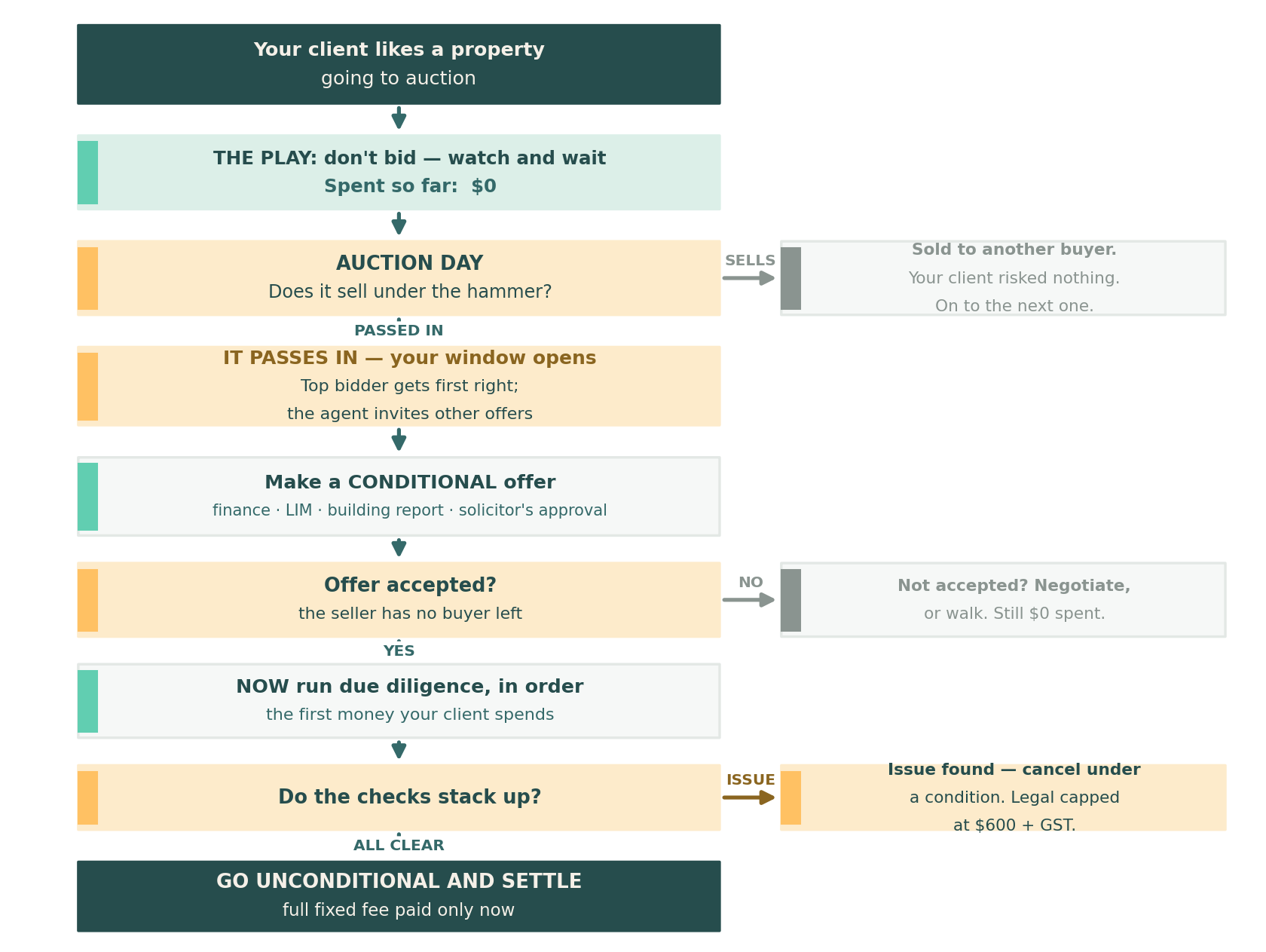
The instant the property is passed in. Before and during the auction, any offer has to be unconditional, which is why a pre-auction offer is a different and riskier animal (see Volume #34). After the pass-in the seller has no buyer and a failed campaign behind them, so a clean conditional offer is suddenly worth their while.
THE MATHS
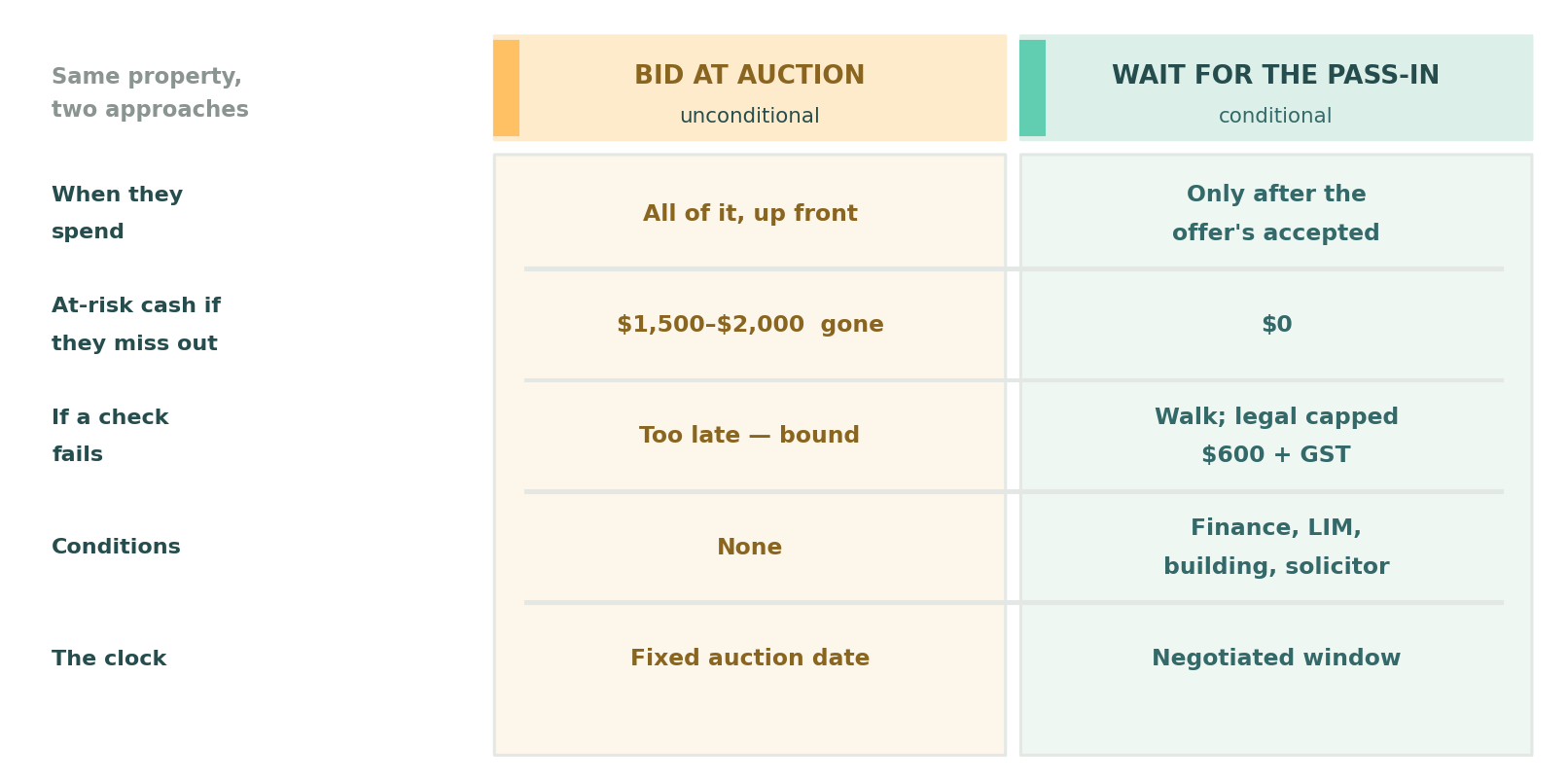
Bidding means spending first and hoping. Waiting means your client spends nothing until their offer is accepted, then runs the checks in order during the conditional period. If something ugly turns up, they cancel under a condition and walk away.
If a condition kills the deal, our legal fee is capped at $600 + GST plus disbursements, not the full fee. The worst case is a known, small number, and your client is never staring at an open-ended legal bill. The full fixed fee is only paid on settlement day, once they actually own the home.
The trade-off: your client might miss out if another buyer swoops in after the pass-in. But they have risked no time and no money to find that out, and they are free to run the same play on the next property. Compare that to losing $2,000 at an auction they did not win.
When a client says ‘there’s an auction this weekend,’ you don’t have to send them into a $2,000 gamble. Point them at the pass-in play: track the result, stay ready, and move with conditions if it doesn’t sell. It keeps their deposit and their due-diligence budget intact for the property they actually win.
This is the one-page visual companion to two earlier issues in the Library: Volume #41 (How to Buy a Property at Auction Without Wasting Money) and Volume #51 (our 3-Week Auction Plan).