Two questions decide whether your client’s KiwiSaver goes on the deposit or on settlement day. Our new tool then walks them through every step, including the one that can’t be done online.
Almost every first-home buyer you see has KiwiSaver in the plan. Most of them assume it just turns up when it’s needed.
It doesn’t. The withdrawal takes up to 10 working days if your client has only worked in NZ, and up to 15 if they’ve worked overseas. The form has to be signed in wet ink in front of a witness. And before any of that, someone has to decide whether the money goes on the deposit or waits for settlement day.
Clients find out about the timing too late. They sign an offer with a standard deposit, expecting KiwiSaver to cover it, and discover the deposit is due as soon as the agreement goes unconditional. Or they’re on the settlement route and sit on the signing step until there aren’t enough working days left.
The other common failure is the signature itself. The withdrawal form includes a statutory declaration, so an e-signed form gets rejected and the clock starts again.
On the deposit route, a late deposit gives the vendor grounds to cancel. On the settlement route, KiwiSaver that hasn’t landed by settlement day means your client can’t settle on time, and that’s when default interest and penalties start.
Either way, the call you get is the urgent one.
1. Is your client buying at auction? At auction the deposit is due when the hammer falls, and KiwiSaver can’t be released that fast. So KiwiSaver goes at settlement, unless the vendor agrees a KiwiSaver deposit clause before auction day.
2. If not, does their cash cover the deposit?
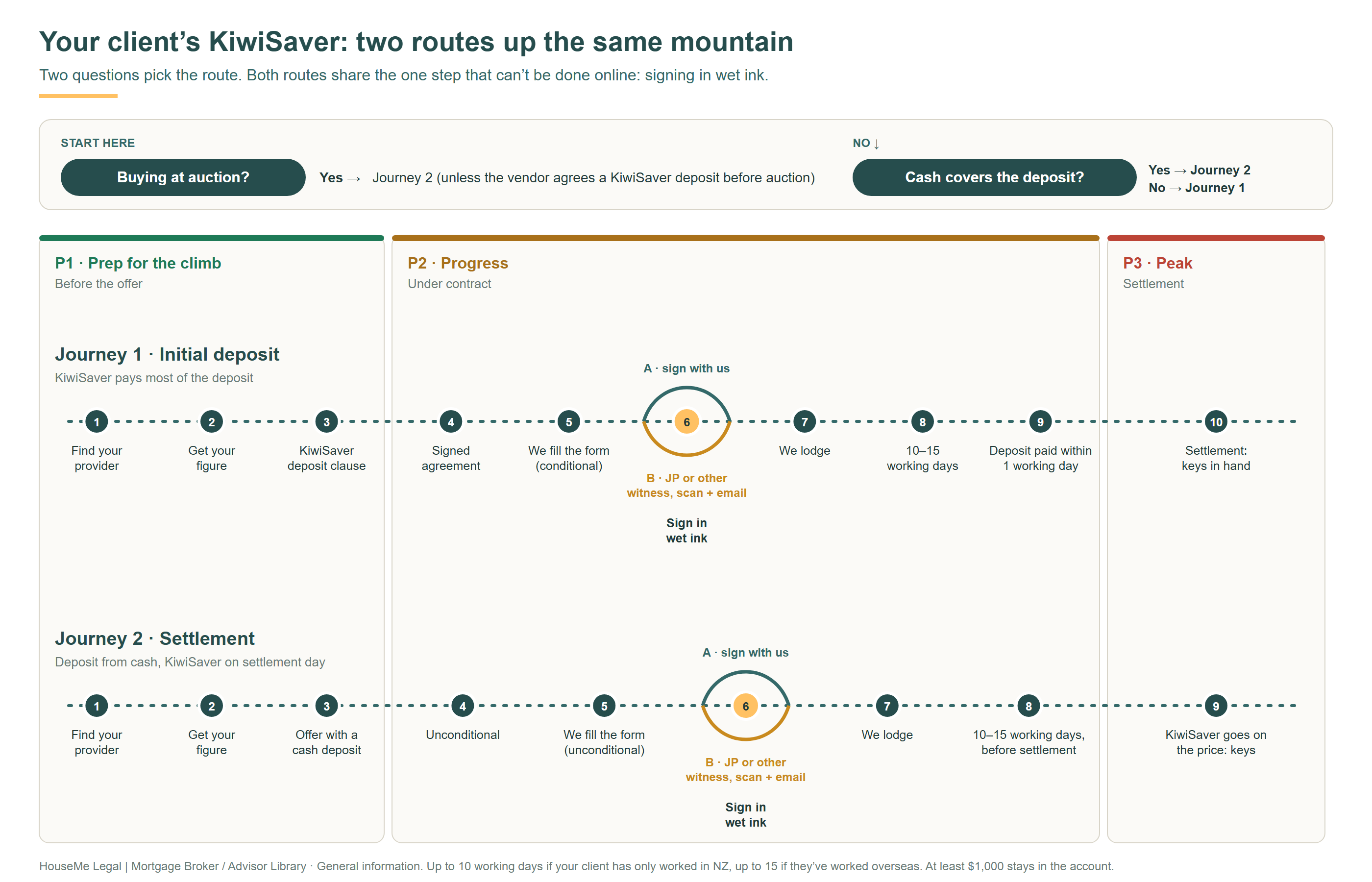
Both routes share one step: signing the declaration in wet ink. There are two ways to do it.
The one rule for Option B: don’t sign before you’re in front of the witness. It’s the most common mistake we see.
We’ve turned all of this into a free interactive tool: the KiwiSaver Road Map.
Your client answers the two questions and the tool picks their route. They then follow it up the mountain, from P1 (prep, before the offer) through P2 (under contract) to P3 (settlement). At the signing step the trail splits into Option A and Option B, and each one shows exactly what to bring and what happens next.
It also knows your client’s provider. They pick it from a list of 17 and the tool shows that provider’s withdrawal form, the email address to ask for their indicative amount (with the email written for them), and our how-to video for that form. The provider details come from our own KiwiSaver master sheet and are checked every night, so a dead link never reaches your client.
A client who knows their route before they offer doesn’t end up with a deposit they can’t pay, or a settlement day their KiwiSaver misses. If they come to us with a signed agreement, we fill in the provider’s form for them.
Book a free first-home buyer consult
“Using your KiwiSaver for your first home? This free map from HouseMe Legal shows whether it goes on your deposit or at settlement, and walks you through every step, including where to sign: https://tools.housemelegal.co.nz/HouseMe-Tool-KiwiSaver-Road-Map”