Read Time: 3 minutes
Our client had a new build in Milldale under contract.
Standard 10-working-day condition for finance.
Everything looked tidy — until the bank flagged an interest on the title: Infrastructure Encumbrance.
That one interest paused the entire deal.
“Will this affect our mortgage security?”
The bank needed written commentary confirming the encumbrance didn’t pose a risk.
When this interest isn’t explained early:
This is an example of a registered interest used by one party (the Encumbrancee) to enforce obligations on the landowner (the Encumbrancer).
If the obligations are breached, or if conditions aren’t followed, then payment becomes due.
If obligations are followed, then typically any annual payment is waived.
Historically, encumbrances were often used by councils to secure things like fencing or land maintenance.
If you complied, no payment was required.
But the interest still sat on the title — and banks hated it.
Why?
Because an encumbrance:
Milldale’s version reflects all of the above — but in a modern, developer-driven form.
The obligation runs with the land and reimburses Milldale Infrastructure LP (MI LP) for bulk works like roading and wastewater systems.
Here’s what brokers and buyers need to be across:
To satisfy the lender and close the loop, we issued a simple explanation:
Conclusion for the Bank:
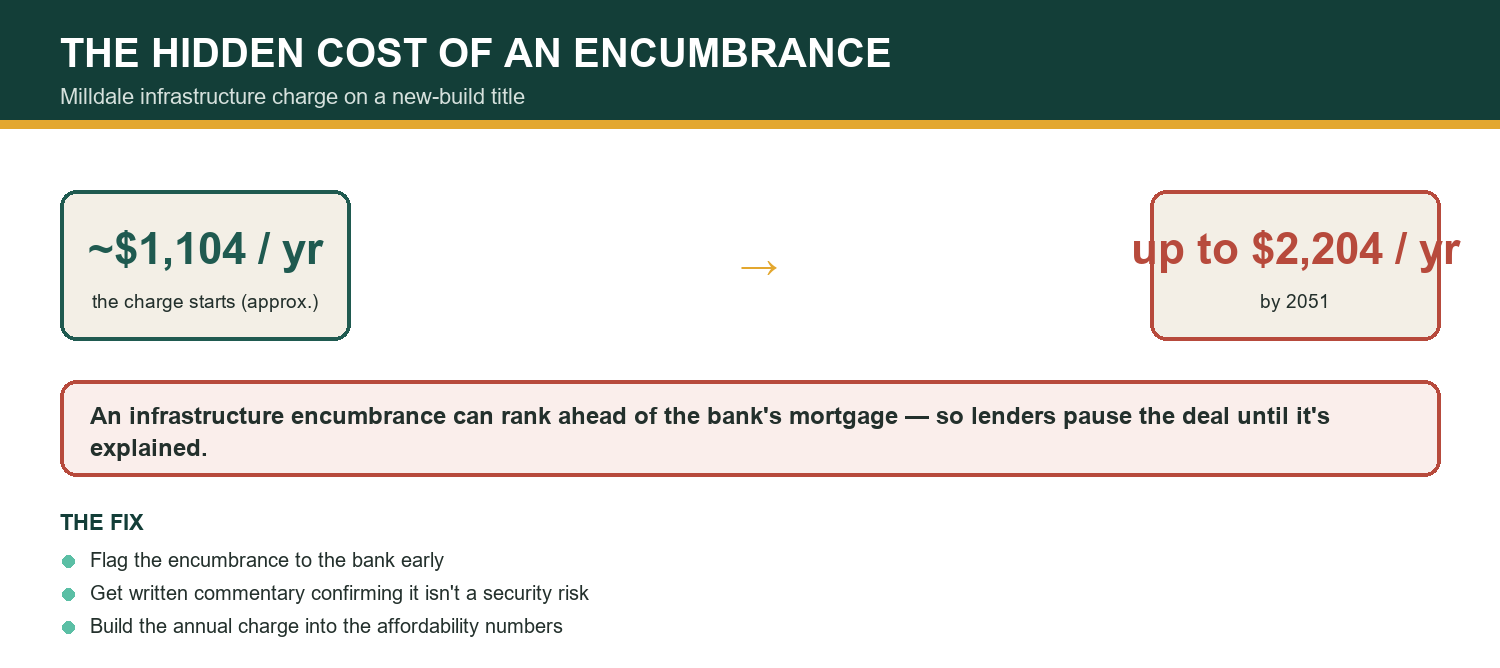
The CIP Payment is akin to additional rates for this property. It starts at $1,104 per year and rises incrementally, reaching $2,204 by 2051. These payments fund bulk infrastructure that benefits the land.
We consider this interest poses a low risk to the bank’s security.