What the residency test misses, and how to spot it before settlement.
Your client's de facto partner doesn't have to have set foot in New Zealand to go on the title.
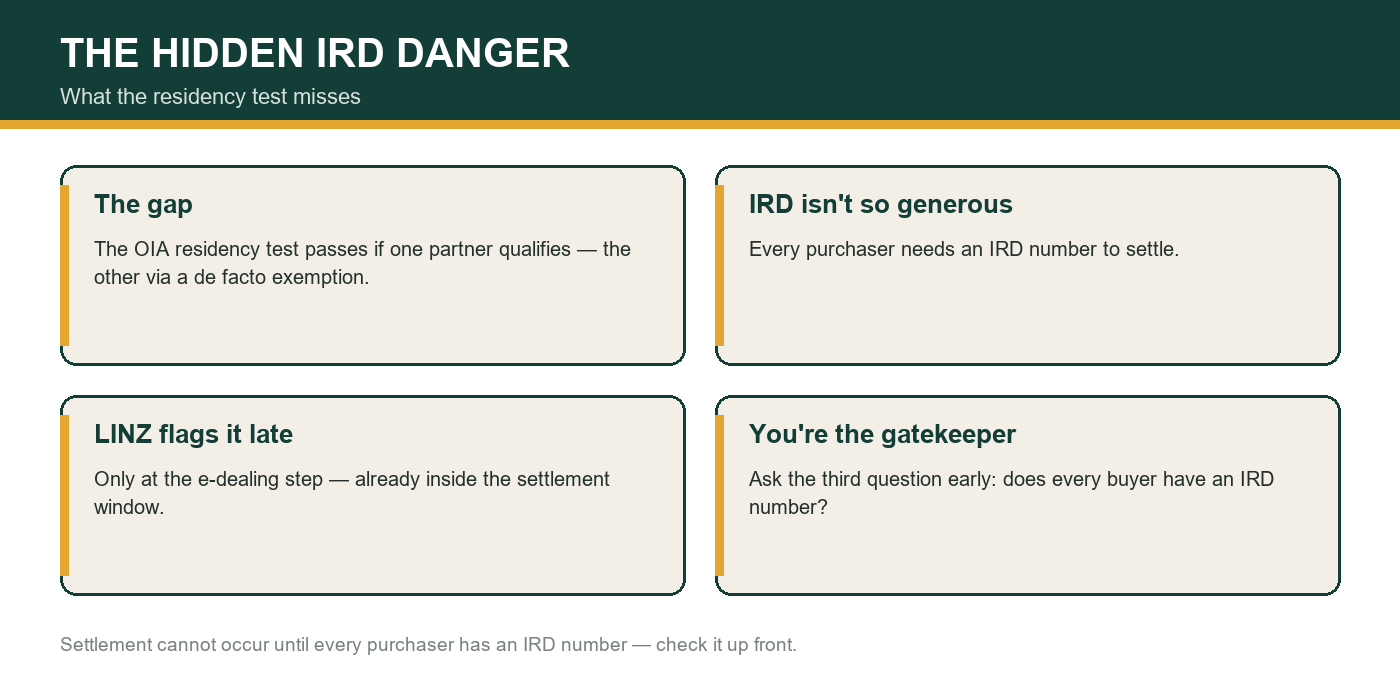
Under the OIA disclosure form's three-step residency test, only one partner needs to qualify.
The other can come in as a de facto and get the Regulation 45 exemption.
The law is generous on that front.
IRD is not.
Every purchaser needs an IRD number to settle.
LINZ doesn't flag the gap until you create the e-dealing — the step where the transfer and mortgage are registered.
Settlement cannot occur without every purchaser having an IRD number.
As the first point of contact, you're already the gatekeeper for two questions: can the client get a loan, and can they actually buy.
This is a third question nobody is asking.
We covered the OIA 3-Step DIY Process in Volume #4.
This trap sits one layer underneath it.
The OIA residency test is satisfied.
One partner qualifies, the other gets the de facto exemption.
The bank's loan adviser doesn't ask.
IRD numbers aren't part of the credit decision.
The seller's lawyer doesn't know your client's tax setup.
By the time anyone realises, you're already inside the settlement window.
The most common version: one partner is working in NZ.
The other is offshore, hasn't been here yet, but is going on the title from day one.
The offshore spouse usually has no IRD number, no NZ tax history, and no incentive to think about it until someone asks.
IRD does not move quickly.
A fresh application from a non-resident or recent migrant can take weeks to come back.
If your client signs an unconditional agreement before that application is in, the clock is already running and you can't pull it back.
That means a delayed settlement at best.
At worst: a default by the purchaser.
Penalty interest under the agreement.
The vendor's lawyer pushing for cancellation.
Add two questions to your intake.
Before pre-approval, not after.
If the answers are no and no, the IRD application gets started that day.
Not after the offer is accepted.
Not after pre-approval.
Immediately.
We've added this to our onboarding at HouseMe Legal.
Thirty seconds at the front saves a frantic call to the seller's lawyer asking for a settlement extension.
✔ The OIA Regulation 45 de facto exemption lets a partner buy without ever having been to NZ.
✔ The IRD rule has no equivalent exemption.
Every purchaser needs one to settle.
✔ LINZ won't flag the gap until you create the e-dealing.
By then, settlement is days away.
✔ Banks don't check for it. It isn't part of the credit decision.
✔ Add the IRD check to your intake before pre-approval.
The migrating-spouse co-purchase is where this trap lives.