You ask your client, “How much deposit have you got?” A week later the agent asks them, “How much deposit will you pay?” Same word, two different questions, and first home buyers often think they’ve already answered the second one.
This is everything your client is putting in from their own pocket: savings, KiwiSaver, a gift from family. It decides how much they borrow and sets the LVR. You know this one well.
This is the deposit written into the Agreement for Sale and Purchase. It’s usually 10% of the price and is paid into the agent’s trust account, either when the agreement is signed or when it goes unconditional. It counts towards the purchase price, and the balance is paid on settlement day.
The agreement deposit is due weeks before the loan is drawn down. The loan only arrives on settlement day, so it can’t pay it. KiwiSaver can, but only if the agreement has a KiwiSaver deposit clause, and the withdrawal takes up to 10 working days (15 if your client has worked overseas).
So a client can have a 20% deposit in your eyes and still be unable to pay the agent.
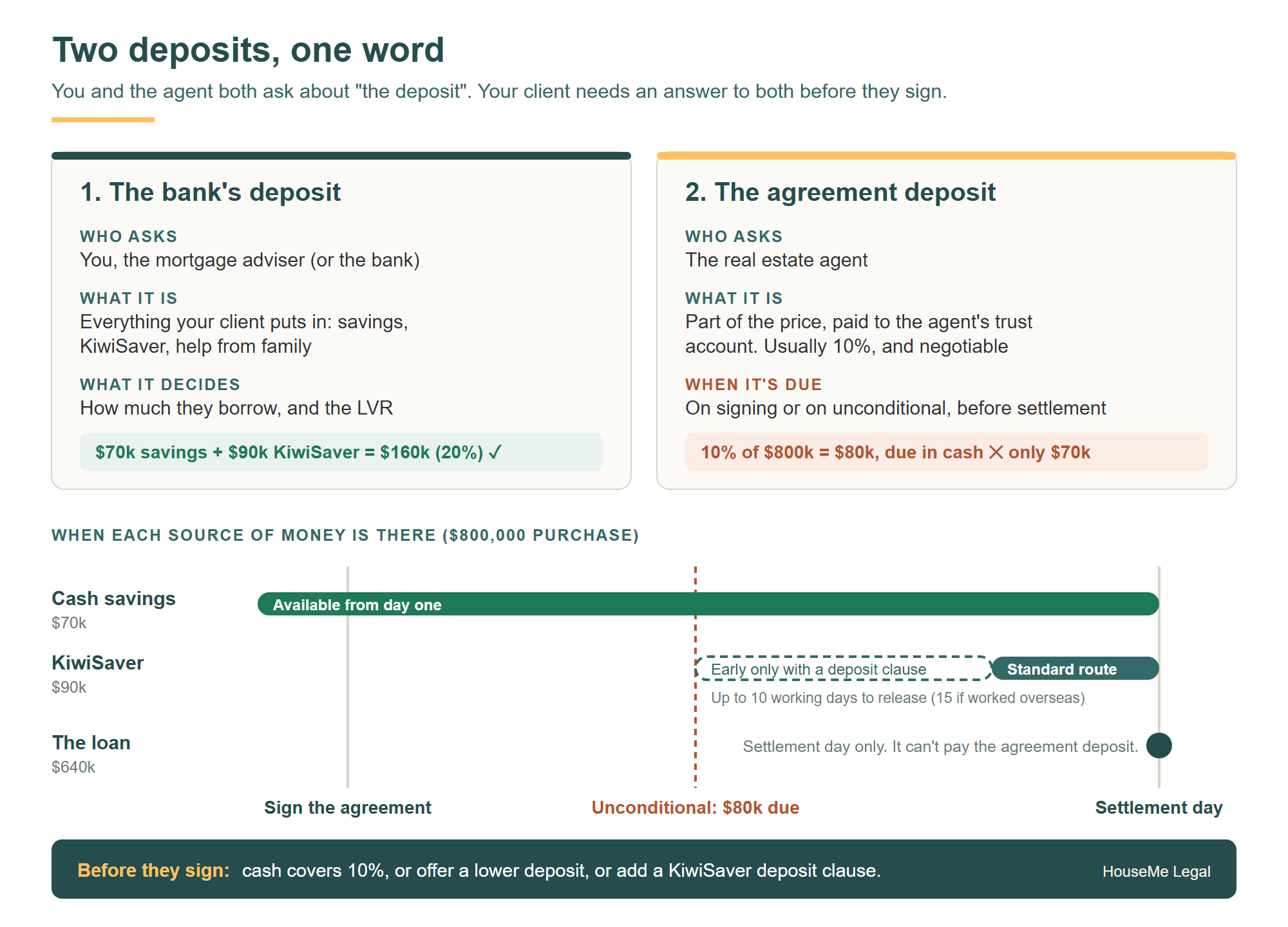
Take an $800,000 purchase. Your client has $70,000 in savings and $90,000 in KiwiSaver: a $160,000 deposit, 80% LVR, approved. The agent writes up a standard 10% deposit, $80,000, due on unconditional. In cash they have $70,000. They’re $10,000 short, and paying the deposit late gives the seller grounds to cancel.
Before your client makes an offer, they need a plan for paying the agreement deposit from money they can reach that week. There are three ways to do it:
1. Cash covers the full 10%. Standard terms are fine. KiwiSaver waits for settlement, and contributions keep going in until then.
2. Offer a lower deposit. It’s negotiable. 5%, or a set dollar figure the cash covers, is common. The seller has to agree.
3. Use KiwiSaver for the deposit, with a clause. The version sellers accept most often is a small cash deposit when the agreement goes unconditional, and the rest within one working day of KiwiSaver landing in our trust account. Full wording is in The KiwiSaver Deposit Playbook (Vol #86).
At auction, option 3 is off the table unless the seller agrees the clause before auction day. The deposit is due when the hammer falls.
The KiwiSaver Road Map starts with the question this issue is about: does your cash cover the deposit? Your client answers it, and the tool picks their route (deposit or settlement), then walks them through each step with their own provider’s form, email and how-to video.

Copy and paste this to any client who’s about to start looking:
Hi [name], one thing to check before you make an offer. The “deposit” we’ve talked about for your loan isn’t the same as the deposit the agent will ask for. The agent’s deposit is usually 10% of the price and has to be paid when the agreement goes unconditional, well before your loan comes through. Work out where that money will come from first. This free tool from HouseMe Legal helps: https://tools.housemelegal.co.nz/HouseMe-Tool-KiwiSaver-Road-Map
If your cash won’t cover 10%, talk to your lawyer before you sign. A lower deposit or a KiwiSaver deposit clause can be written into the offer.
Seen a client get caught by this? Hit reply and tell me how it played out. I’m collecting these for a future issue.